

Most people don’t want to deal with complicated investment theories. Rather, they just want their money to grow faster. Keeping everything in a savings account feels safe, but over time, you realise it’s not really helping. Prices rise, expenses increase, and the interest barely makes a difference. Over time, inflation reduces the purchasing power of money, a concern highlighted by the Reserve Bank of India, which is why relying only on savings accounts is often not enough for long-term growth.
How to grow money fast is a common financial goal, but it is often misunderstood. Many people associate fast growth with shortcuts, risky bets, or schemes promising unrealistic returns. In reality, smart investing is not about gambling or chasing trends. It is about using the right strategies, choosing suitable instruments, and staying disciplined over time.
At the same time, everyone has heard stories of people losing money while chasing “quick returns.” Take risks, but not the wrong ones. That’s where smart investing comes in.
“Fast” Growth Is Relative
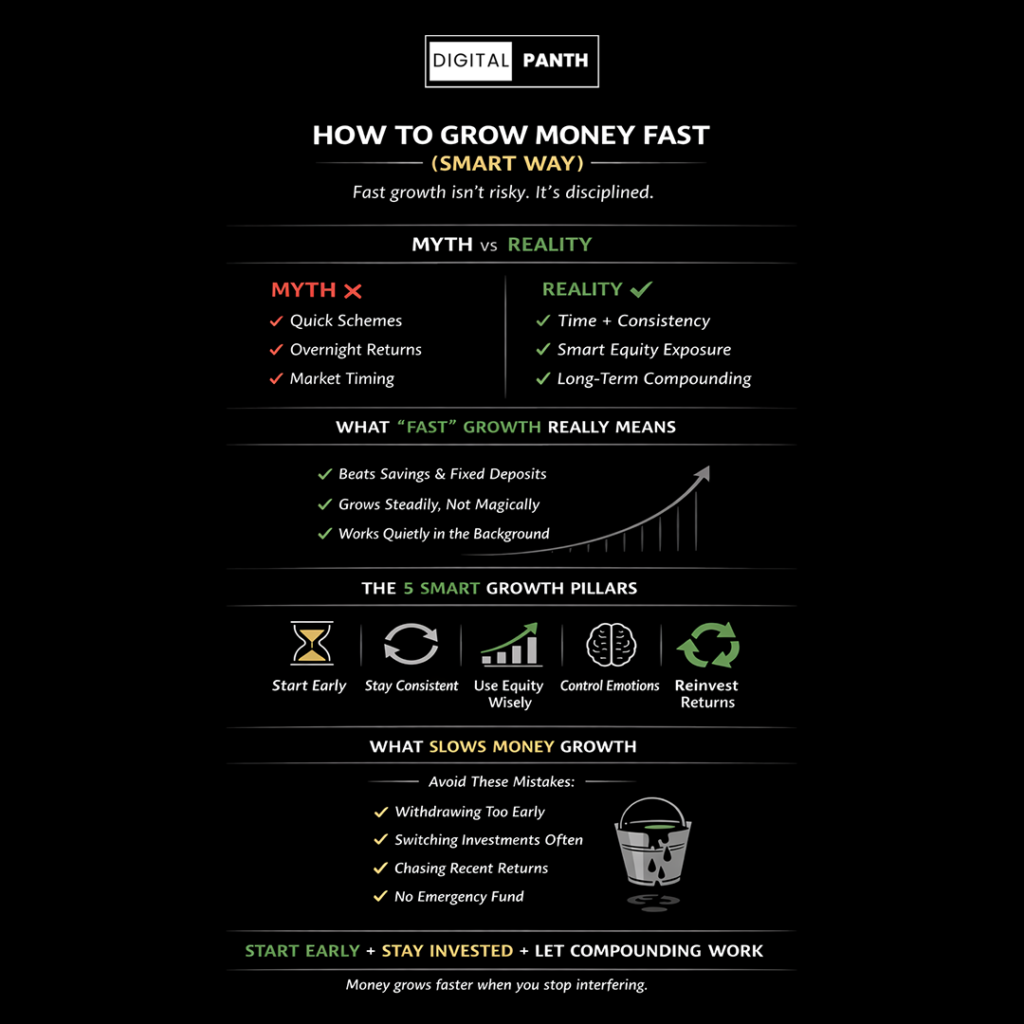
Growing money fast does not mean doubling it in a year. In practical terms, fast growth usually means:
- Earning better returns than fixed deposits
- Seeing money grow steadily over time
- Not constantly moving funds based on market noise
If your investments are quietly compounding while you focus on life, that is already progress.
The challenge is that compounding does not look impressive in the beginning. For the first few years, growth feels slow and almost unrewarding. This is exactly the stage where many people give up, just before compounding starts doing its real work.
Time Is the One Thing You Can’t Replace
There is a big difference between starting early and starting “when things feel right.” Most people delay investing because:
- Markets feel risky
- Income feels insufficient
- They believe they will start later
Unfortunately, later often turns into much later. Someone who invests small amounts early often ends up ahead of someone who invests larger sums much later. This difference has less to do with intelligence and more to do with time. Time allows compounding to work, and once lost, it cannot be recovered.
Time may feel unfair, but it can work strongly in your favour if you use it wisely.
Equity Isn’t Optional If Growth Is the Goal
If faster growth is the goal, equity has to be part of the plan. There is no real alternative. Equity does not mean reckless stock picking. It simply means allowing your money to participate in business growth. Over long periods, businesses expand, profits rise, and markets reflect that progress.
This is why equity mutual funds work well for most people. They are not exciting, and they do not deliver instant results, but they are effective. Systematic Investment Plans (SIPs) make the process even simpler by removing decision-making from monthly investing.
You invest regularly, ignore short-term noise, and let time do its job. Over the years, that discipline shows results.
Consistency Beats Intelligence
One of the most overlooked truths in investing is that consistency matters more than being smart. People who frequently stop and restart investments often underperform, even if they choose good funds. SIPs are paused during market falls and restarted during rallies. While this feels logical, it works against long-term growth.
Those who continue investing even when markets feel uncomfortable often benefit later—not because they predicted anything, but because they stayed consistent.
Lump Sum Money Can Help or Hurt
Receiving a bonus or a large sum of money often creates pressure to act quickly. Some people invest everything immediately, while others wait indefinitely. Neither extreme works well.
A balanced approach is usually better:
- Invest a portion immediately
- Spread the remaining amount over tim
- Keep long-term goals in focus
Lump sum investing works best when it supports an existing plan rather than replacing it.
Stocks Can Grow Money Faster, But Only With Patience
Direct stock investing is attractive because of its potential for higher returns. And yes, stocks can grow money faster than many other instruments. However, this works only when:
- Decisions are based on understanding, not excitement
- Holding periods are long
- Emotional reactions are controlled
Most stock market losses occur not because companies are bad, but because decisions are driven by fear or greed. If market fluctuations make you uncomfortable, it is wiser to keep direct stock exposure limited and rely more on mutual funds.
Money Grows Better When It Has a Reason
Random investing rarely leads to strong outcomes. When money is linked to clear goals such as buying a home, funding education, or building long-term security, then the decision-making improves automatically. You stop reacting to short-term fluctuations and start thinking in years rather than weeks.
Clear goals bring clarity to risk-taking.
Most Growth Is Lost Through Small Mistakes
Very few people lose money because of one big mistake. Most losses happen slowly through small, repeated actions such as:
- Withdrawing money too early
- Switching funds too often
- Chasing recent returns
- Ignoring asset balance
Individually, these actions may not feel harmful. Over time, however, they significantly slow wealth creation. Often, doing less—and interfering less—produces better results.
Reinvesting Is Quietly Powerful
Withdrawing returns often feels rewarding in the short term, while reinvesting them may seem boring. However, boring is powerful. When dividends, interest, and gains are reinvested, compounding accelerates without any extra effort.
Over time, this creates a clear difference between average and strong portfolios. If the money is not immediately required, letting it remain invested usually works in your favour.
Review, Don’t Micromanage
Checking investments daily creates anxiety, while ignoring them entirely leads to neglect. A balanced approach works best:
- Review your portfolio once or twice a year
- Rebalance if one asset grows disproportionately
- Adjust if income or goals change
This keeps investments aligned without emotional interference.
Liquidity Protects Long-Term Growth
One of the main reasons people exit investments at the wrong time is unexpected emergencies. Keeping emergency funds separate protects long-term investments.
Liquidity does not slow growth; instead, it ensures that long-term plans remain uninterrupted.
What Really Works When It Comes to Growing Money Fast
There is no single investment that guarantees fast growth. What actually works is:
- Starting earlier than you feel ready
- Staying consistent even when it feels uncomfortable
- Using equity sensibly
- Giving compounding time
- Avoiding emotional decisions
It may not be exciting or dramatic, but it is effective.
Conclusion
Growing money fast is not about speed; it is about avoiding the actions that slow it down. When you stay disciplined, remain invested, and allow time to do its work, money grows quietly in the background. Over time, the results become visible—not overnight or magically, but steadily and sustainably.
Frequently Asked Questions (FAQs)
Can I really grow money “fast” without taking huge risks?
Yes. “Fast” growth means earning better returns than traditional savings over time through disciplined, long-term investing, not chasing risky shortcuts.
Is equity necessary to grow money faster?
If growth is the goal, equity exposure is important. It allows your money to benefit from business and economic growth, especially over the long term.
How often should I review my investments?
Reviewing once or twice a year is usually enough. Frequent checking can lead to emotional decisions that hurt long-term returns.
Disclaimer: This article is for informational and educational purposes only. It does not constitute financial, investment, or tax advice. Investment decisions should be made based on individual goals, risk tolerance, and financial situation. Past performance does not guarantee future results. Consider consulting a qualified financial advisor before making any investment decisions.
